
The 1200cc segment has always been the engine room of Indian car sales — it’s where the Swift, the Dzire, the Punch and the Nexon live, and between them these cars move more metal every month than every luxury brand in the country combined. But 2026 has been an unusually eventful year for this class. A tax overhaul in September 2025 changed what these cars cost overnight, several familiar nameplates have quietly gone off sale, and the best-seller crown has changed hands. Here’s the list, rebuilt from the ground up for 2026.
What Actually Changed Since Last Year
Two things reshaped this segment over the past twelve months, and both matter more than any single new launch.
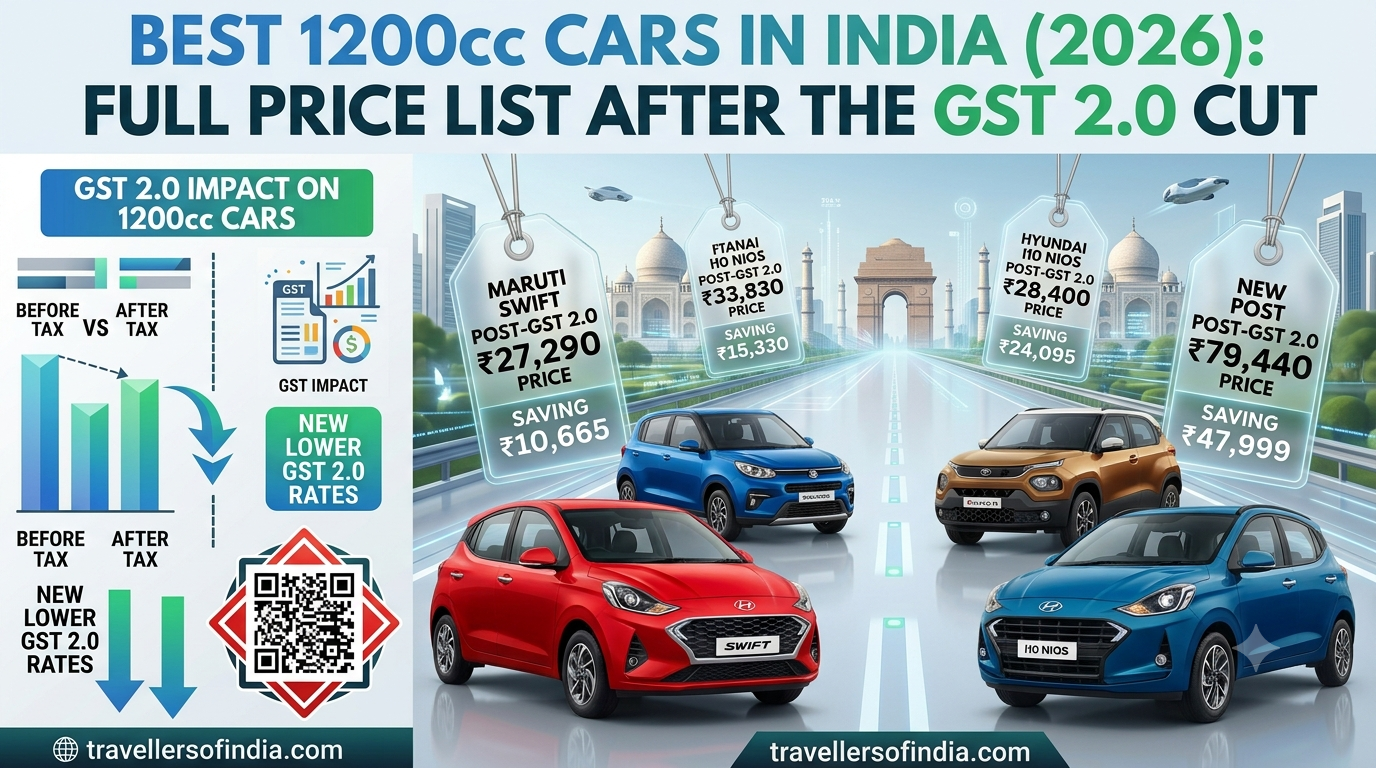
The GST cut. Under the GST 2.0 reform that came into effect on 22 September 2025, the government collapsed the old multi-slab structure — 28% GST plus a compensation cess of up to 22% — into just two flat rates: 18% for small cars and 40% for everything larger. To qualify for the 18% slab, a petrol or CNG car needs a sub-1200cc engine and a length under 4000mm (diesel cars get a 1500cc allowance instead). Every car in this list clears that bar, and every one of them got cheaper as a direct result — typically by ₹50,000 to ₹80,000 on a ₹6–10 lakh hatchback, with the compensation cess gone entirely. It’s the single biggest reason to hold off on an older price list from 2025.
The lineup itself has thinned out. A few cars that regularly showed up on “1200cc cars in India” lists a year or two ago are no longer sold here at all — Ford exited the Indian passenger car market some years back, Volkswagen discontinued the Polo and Vento, Honda pulled the WR-V, Nissan stopped selling the Kicks locally, Mahindra retired the KUV100, Datsun shut down in India entirely, and Skoda’s Rapid sedan is gone too. If you see any of these on another site’s “2026” list, that list hasn’t actually been updated. We’ve dropped them here and kept the count honest at 25 rather than padding it back up to 30 with cars you can no longer buy.
The pecking order flipped. For years the Maruti Suzuki Dzire was untouchable as India’s best-selling car, and it still topped the full FY2026 sales chart with over 2.29 lakh units. But in June 2026, the Tata Punch pulled off a genuine surprise, ending the month as the outright best-seller and pushing the Dzire down to third place — a sign of how much weight compact SUVs now carry in this engine class.
Why 1200cc Still Matters
A 1.2-litre naturally aspirated or turbocharged petrol engine remains the sweet spot for Indian conditions: enough torque low down for stop-start city traffic, enough legs for a highway overtake, and — post-GST 2.0 — a meaningful tax advantage that engines above 1200cc (petrol) simply don’t get. Pair that with a sub-4000mm body and a manufacturer avoids the 40% slab entirely, which is why almost every mass-market car in India is still deliberately engineered to this exact formula.
The Full List: 1200cc Cars in India, 2026
All prices are ex-showroom, Delhi, and approximate — variant-wise pricing will vary by trim, transmission and city. CNG and automatic variants sit at the top of each range.
Hatchbacks
| # | Model | Engine (cc) | Length (mm) | Price Range (₹ Lakh) | Notes |
|---|---|---|---|---|---|
| 1 | Maruti Suzuki Swift | 1197 | 3860 | 5.79 – 8.84 | Fourth-gen model, six airbags standard on all variants |
| 2 | Maruti Suzuki Baleno | 1197 | 3995 | 5.99 – 9.10 | Roomiest cabin in the segment, CNG available |
| 3 | Hyundai Grand i10 Nios | 1197 | 3805 | 5.47 – 8.04 | 8-inch touchscreen, wireless charging on top trims |
| 4 | Hyundai i20 | 1197 | 3995 | 6.00 – 10.44 | Premium hatch positioning, sunroof and ADAS-lite on top trims |
| 5 | Tata Tiago | 1199 | 3765 | 4.70 – 8.55 | Cheapest way into a 5-star Global NCAP hatchback |
| 6 | Tata Altroz | 1199 | 3990 | 6.30 – 10.51 | Strongest crash-test scores in the class |
| 7 | Toyota Glanza | 1197 | 3995 | 6.73 – 9.99 | Rebadged Baleno, Toyota’s dealer network and warranty |
| 8 | Maruti Suzuki WagonR | 1197 | 3655 | 4.99 – 6.95 | Tall-boy practicality, CNG the volume seller |
| 9 | Maruti Suzuki Ignis | 1197 | 3700 | 5.35 – 7.50 | Quirky styling, smallest turning radius in its class |
| 10 | Citroen C3 | 1199 | 3981 | 4.80 – 6.85 | Among the cheapest entry points into the segment |
Sedans
| # | Model | Engine (cc) | Length (mm) | Price Range (₹ Lakh) | Notes |
|---|---|---|---|---|---|
| 11 | Maruti Suzuki Dzire | 1197 | 3995 | 6.26 – 9.36 | India’s best-selling car for FY2026 overall; 5-star Global NCAP and Bharat NCAP |
| 12 | Hyundai Aura | 1197 | 3995 | 6.00 – 8.54 | Strongest CNG mileage figures in the class |
| 13 | Tata Tigor | 1199 | 3993 | 6.35 – 9.20 | Altroz’s sedan sibling, roomy boot |
| 14 | Honda Amaze | 1199 | 3995 | 7.20 – 10.50 | Most refined engine feel in the segment |
Compact & Micro SUVs
| # | Model | Engine (cc) | Length (mm) | Price Range (₹ Lakh) | Notes |
|---|---|---|---|---|---|
| 15 | Tata Punch | 1199 | 3827 | 5.60 – 10.55 | India’s outright best-selling car in June 2026 |
| 16 | Tata Nexon | 1199 turbo | 3993 | 8.15 – 14.15 | Turbo-petrol only in this engine size; segment sales leader |
| 17 | Maruti Suzuki Fronx | 1197 | 3995 | 6.85 – 11.98 | Coupe-SUV styling, strong resale value |
| 18 | Hyundai Exter | 1197 | 3815 | 5.64 – 9.61 | Segment-first features like a sky-view sunroof |
| 19 | Mahindra XUV 3XO | 1198 turbo | 3995 | 7.49 – 13.99 | Only car here with an optional Level 2 ADAS package |
| 20 | Hyundai Venue | 1197 | 3995 | 7.53 – 13.50 | Two turbo-petrol states of tune available |
| 21 | Kia Sonet | 1197 | 3995 | 7.30 – 13.65 | Widest variant spread — nine trims |
| 22 | Nissan Magnite | 1197 | 3994 | 5.62 – 10.96 | Sharpest pricing at the base end |
| 23 | Renault Kiger | 1199 | 3991 | 6.00 – 8.80 | Most affordable turbo-petrol SUV badge in the class |
Beyond the 4-Metre Mark (1.2L Engine, Larger Body)
These two don’t get the small-car GST rate because of their length, but they carry the same-size engine and are worth knowing if space matters more than the tax break:
| # | Model | Engine (cc) | Length (mm) | Price Range (₹ Lakh) | Notes |
|---|---|---|---|---|---|
| 24 | Citroen C3 Aircross | 1199 turbo | 4323 | 8.99 – 13.50 | Three-row seating option, taxed at 40% GST |
| 25 | Tata Curvv | 1199 turbo | 4308 | 9.65 – 14.50 | Coupe-SUV design, also sold as a straight EV |
How the GST Cut Actually Plays Out at the Showroom
Take a car priced at ₹8 lakh ex-showroom before September 2025. Under the old regime, GST plus cess on a sub-4m petrol hatchback worked out to roughly 29–31% of the factory price. Post-reform, that’s a flat 18%, no cess. On an ₹8 lakh car, that’s the difference between roughly ₹2.24 lakh and ₹1.44 lakh in tax — a saving that flows straight through to the ex-showroom sticker. It’s a big enough shift that Maruti Suzuki posted its highest-ever monthly sales in April 2026, up 35% year-on-year, and dealers across the segment have reported showroom footfall not seen since before the pandemic.
Buyer Notes for 2026
- Check the engine tune, not just the “1200cc” badge. Tata Nexon, Mahindra XUV 3XO, Renault Kiger and the Citroen twins all offer a turbocharged 1.2-litre in place of a naturally aspirated one — more power and torque, usually a small mileage trade-off.
- CNG has gone from niche to mainstream in this class. Dzire, Punch, Tiago, Altroz, Baleno, WagonR and Aura all offer factory-fit CNG, and the fuel-cost gap versus petrol has only widened this year.
- Resale and service network still separate the pack more than spec sheets do. Maruti and Hyundai continue to lead on both counts; Tata has closed most of the gap on safety and infotainment but is still catching up on resale values in some markets.
- Watch the 4-metre line if budget is tight. Stepping even a few millimetres over it — as with the C3 Aircross or Curvv — pushes a car into the 40% GST slab, which is a far bigger price jump than any feature upgrade.
What’s Coming Next
A few names to watch for the rest of 2026: Renault has teased the Bridger, a new sub-4m compact SUV expected to slot into this exact segment, and Tata Motors’ management has flagged a flex-fuel version of the Punch as a likely candidate for launch before year-end, aimed at further trimming running costs for CNG-hesitant buyers. Neither is confirmed for sale yet, so they’re not in the table above — but both are aimed squarely at this class.
Conclusion
The 1200cc bracket remains the most competitive, most closely watched part of the Indian car market, and 2026 has genuinely reshuffled it — cheaper thanks to GST 2.0, shorter on nameplates than it was a year or two ago, and led at the very top by a compact SUV for the first time in years. Whichever body style you’re after, this is still where the value is.
Sources: