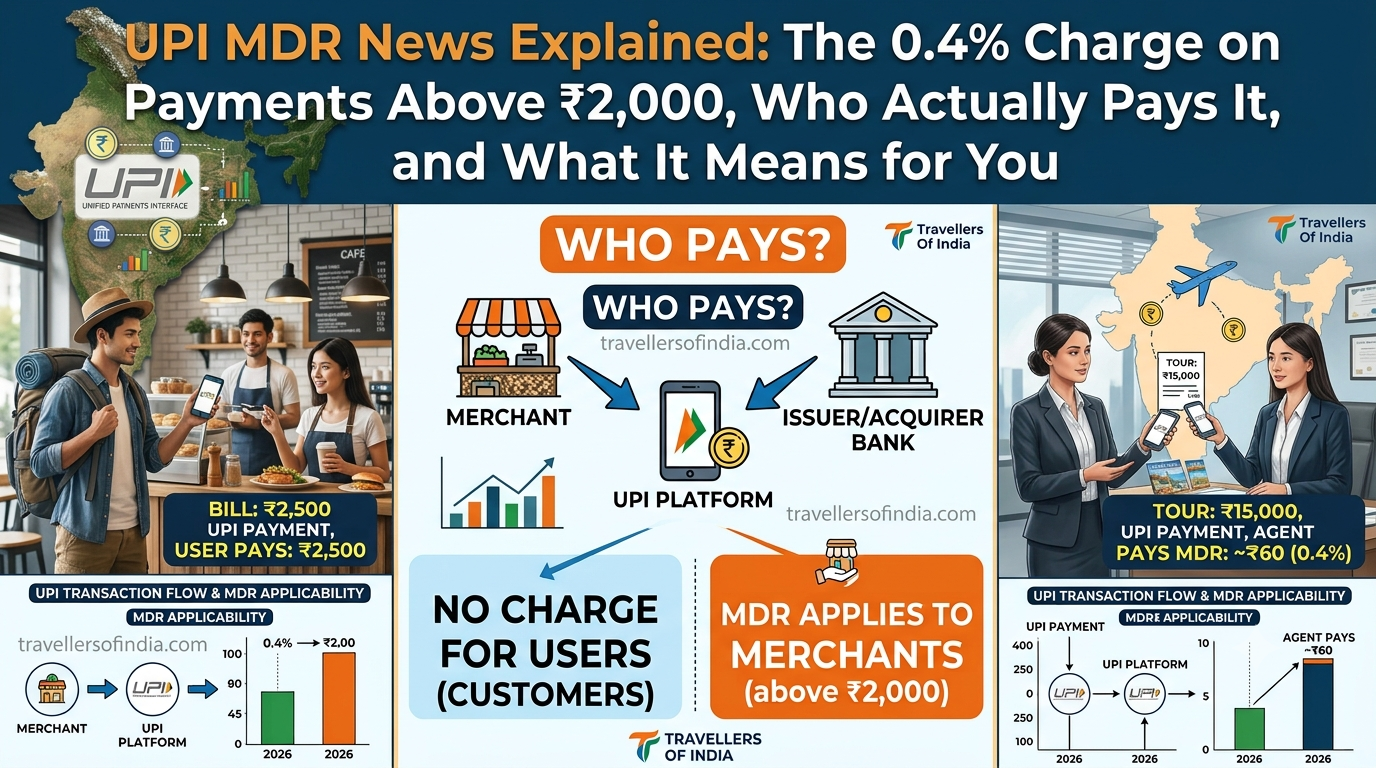

If you’ve used UPI even once this week, you’ve probably already seen some version of this headline: UPI is getting a fee. It isn’t quite that simple, and after two months of tracking this story from the first parliamentary skirmish over it in August to the National Payments Corporation of India’s formal announcement this week, I can tell you the actual mechanics matter a lot more than the headline does. Here’s every detail, laid out the way I’d want it explained to me before I made a single payment differently because of it.
What Actually Happened, In One Paragraph
On September 15, 2026, the National Payments Corporation of India (NPCI) announced a revised Merchant Discount Rate (MDR) framework for UPI. Starting October 15, 2026, Person-to-Merchant (P2M) UPI transactions above ₹2,000 will attract an MDR of 0.4%, capped at ₹300 for any single transaction of ₹75,000 or more. Person-to-Person (P2P) transfers — sending money to friends, family, splitting a bill, or moving money between your own linked accounts — remain completely free, at any amount, with no change at all. Small merchants who receive up to ₹1 lakh a month via UPI QR codes directly into their bank accounts also stay outside the charge entirely, regardless of how large an individual transaction is. And the charge, per NPCI and the Finance Ministry’s own repeated clarification, is levied on the merchant, not on you as the customer.
What Is an MDR, Actually?
A Merchant Discount Rate is the fee a merchant pays to the banks, payment app, and network that process a digital transaction on their behalf — it’s the cost of accepting a non-cash payment, essentially, and it’s existed for decades on credit and debit cards. Credit cards typically carry an MDR of 1% to 3%; debit cards, somewhere around 0.8% to 0.9%. UPI, since its launch, had operated on a zero-MDR basis for P2M transactions — a deliberate policy choice, formalised by the Central Board of Direct Taxes in January 2020, meant to get merchants of every size onto digital payments without any acceptance cost standing in the way. That’s the default this new framework is now partially rolling back, for a specific slice of transactions.
The Full Charge Table: What Gets Charged, and What Doesn’t – (Table)
| Transaction Type | Threshold | Charge | Who Pays | Example |
|---|---|---|---|---|
| Person-to-Person (P2P) | Any amount | 0% — Free | No one | Sending ₹50,000 to a family member costs nothing |
| Person-to-Merchant (P2M), any merchant | Up to ₹2,000 | 0% — Free | No one | Buying groceries for ₹1,800 costs nothing extra |
| Person-to-Merchant (P2M), general merchants | Above ₹2,000, up to ₹75,000 | 0.4% MDR | Merchant | A ₹5,000 payment costs the merchant ₹20 |
| Person-to-Merchant (P2M), general merchants | ₹75,000 and above | 0.4% MDR, capped at ₹300 | Merchant | A ₹1,00,000 payment costs the merchant ₹300, not ₹400 |
| Small merchants (P2PM: up to ₹1 lakh/month via UPI QR) | Any amount | 0% — Free | No one | A street vendor’s ₹3,000 sale remains free regardless |
| Specified categories: Railways, telecom, insurance, fuel | Above ₹2,000 | Flat ₹5 per transaction | Merchant | A ₹4,000 fuel payment costs the fuel outlet ₹5, not a percentage |
The Full Charge Table: What Gets Charged, and What Doesn’t – (Image)
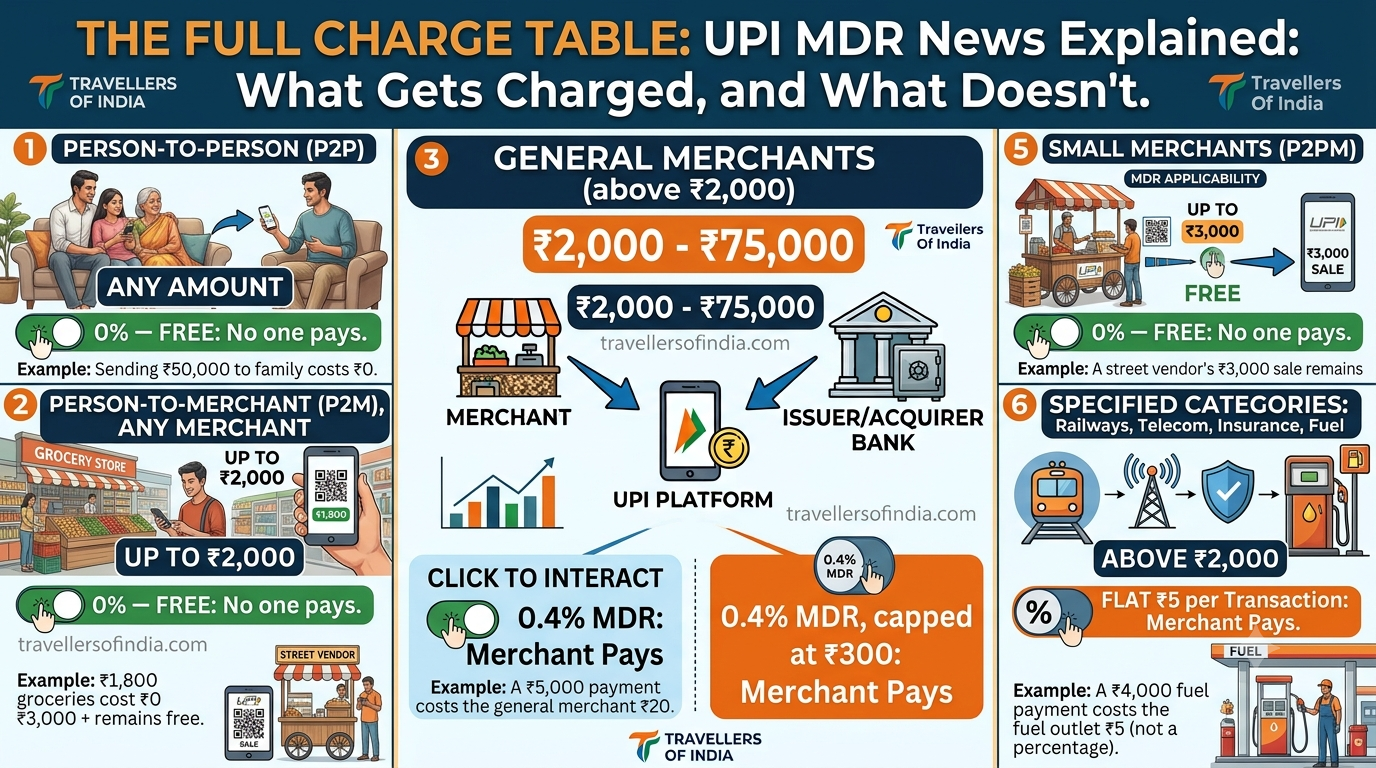
Two things worth underlining from that table: the 0.4% is a merchant-side cost, not something added on top of what you pay, and it only kicks in above ₹2,000 — which NPCI says covers more than 95% of all UPI P2M transaction volume in terms of how many transactions people actually make. Note the distinction NPCI itself draws between volume and value here: even though 95%+ of individual transactions stay untouched, industry estimates (from CareEdge Ratings) suggest roughly 67% of P2M transaction value happens above the ₹2,000 mark — meaning the rupee value flowing through this fee is proportionally larger than the transaction count suggests, even if it’s still a minority of overall UPI value once P2P transfers are included.
The Legal Backdrop: Why This Needed a Law Change First
This didn’t happen through a simple NPCI notice out of nowhere — it required an actual amendment to the Payment and Settlement Systems Act. Section 10A of that Act had, until this year, contained a blanket statutory guarantee of zero MDR on UPI and RuPay debit card transactions. The Taxation and Other Laws (Amendment) Bill, 2026, passed by Parliament this year, removed that blanket guarantee and instead gave the Central government the legal authority to decide which digital payment modes or transaction types would remain fee-free going forward. The Bill itself didn’t set any fee — it simply opened the door. On September 14, 2026, the Finance Ministry issued the actual notification applying MDR eligibility to RuPay debit cards and UPI transactions above ₹2,000, which then handed the job of setting the exact rate to NPCI’s UPI and Services Steering Committee — a 22-member body made up of banks, payment companies, and industry associations including the Payments Council of India and the Indian Banks’ Association. That committee’s decision is what produced the 0.4% figure a day later.
The Political Story: Who Said What
This has been a live political argument since August, and it’s worth knowing the sequence, because the numbers that got debated in Parliament don’t quite match the numbers NPCI eventually announced.
On August 6, 2026, Congress leader Jairam Ramesh posted that the Taxation and Other Laws (Amendment) Bill “eliminates the statutory guarantee that had so far kept UPI transactions fee-free,” warning that the cost would eventually be passed on to ordinary users even if it was formally charged to merchants. Finance Minister Nirmala Sitharaman responded directly on the same platform, stating plainly that “Merchant Discount Rate (MDR) applies only on the merchants and not on the end users/customers,” and that any revenue generated would help banks and fintech companies invest in infrastructure, innovation, and fraud prevention — benefits she argued would flow back to users indirectly. She also stressed at the time that no decision on an actual MDR had been made yet, and that the Steering Committee would only take it up after the Bill passed into law.
When NPCI’s actual announcement landed in mid-September, BJP IT cell head Amit Malviya publicly rejected an earlier Congress claim that a 0.5% fee was coming, calling it “completely false” — the real figure, once confirmed, turned out to be 0.4%, not 0.5%. Congress, for its part, maintained after the announcement that the government was “using new laws bulldozed through Parliament to start the process of charging for UPI,” framing the 0.4% MDR as validation of their original warning regardless of the exact number.
Why Now — The Stated Rationale
NPCI’s own explanation centres on sustainability. UPI has grown from ₹21.3 lakh crore in transaction value in FY 2019-20 to ₹260.56 lakh crore by March 2025 — more than a twelvefold increase in five years — and now serves over 55 crore users through hundreds of participating banks and payment service providers. Maintaining that infrastructure, along with the cybersecurity and fraud-prevention systems a network that size needs, costs money that a permanently zero-revenue model can’t indefinitely cover on its own. NPCI has run a separate government-funded incentive scheme since FY 2021-22 specifically to compensate banks and payment apps for low-value P2M transactions, but a reintroduced, if narrow, MDR is effectively the ecosystem’s way of building a more self-sustaining revenue base for the higher-value end of the transaction pool, without touching the small, everyday payments that make up the bulk of UPI’s actual use.
What This Means If You’re Booking Travel
Since this piece sits in our travel finance section, here’s the part that actually matters if you use UPI to pay for flights, hotels, cabs, or travel insurance: most travel bookings — a flight ticket, a hotel stay, a long cab ride — comfortably cross the ₹2,000 threshold, so the merchant side of that transaction (the airline, the OTA, the hotel, the insurer) will now be paying the 0.4% MDR, capped at ₹300 for anything ₹75,000 and above. Based on the Finance Ministry’s own repeated position, that cost is not meant to be passed on to you directly at the point of payment — but whether travel platforms quietly build it into service fees or convenience charges over time is a fair thing to watch for in the months after October 15, the same way airlines have historically adjusted “convenience fees” around other cost changes. Travel insurance, specifically, falls into a slightly different bucket if NPCI treats it under the same flat-fee logic used for insurance more broadly — worth checking the fine print on your provider’s payment page once the new framework is live.
What Doesn’t Change, Worth Repeating
- Sending money to friends and family: still free, any amount, always.
- Splitting a bill on UPI: still free.
- Paying for your morning chai, groceries, or an auto ride under ₹2,000: still free, for any merchant.
- Buying from a small vendor or shopkeeper who takes under ₹1 lakh a month via UPI QR: still free, even on a single large purchase.
- Your UPI app itself: still free to use, download, and hold — this is a merchant-side transaction cost, not a subscription or usage fee on the payer.
The Open Questions Worth Watching
A few things weren’t fully settled as of this announcement, and are worth tracking as October 15 approaches: whether GST will apply on top of the newly reintroduced MDR (the government had previously confirmed no GST applied specifically because no MDR existed — that logic may now flip, though this hasn’t been explicitly clarified for the new framework), whether large aggregator platforms and e-commerce merchants absorb the 0.4% quietly or restructure pricing and “convenience fees” around it, and how the dedicated fund NPCI has proposed for small-merchant digital infrastructure in Tier 3 markets actually gets structured and funded. None of these change what you, as an everyday UPI user sending money or paying under ₹2,000, will experience on October 16. But they’re the details that will determine how visible or invisible this fee ends up being to the average Indian consumer a year from now.
Reference Links:
UPI Charges To Be 0.4% For Some Payments Above Rs 2,000. Free For Consumers
Merchants to be charged 0.4% for UPI transactions over ₹2,000; small vendors exempt – The Hindu